


The Economy Is Sending Mixed Signals. Housing Is Feeling All of Them.
The U.S. economy is sending a complicated message. Inflation improved sharply in June, but mortgage rates moved higher. The unemployment rate remains relatively low, yet hiring has slowed. Housing starts jumped, but the increase came almost entirely from multifamily construction, while single-family activity remained weak. Existing home sales are running above last year’s level, but they remain far below what was once considered a normal market.
Taken together, these indicators do not point to either a housing boom or an imminent collapse. They describe a market constrained by high borrowing costs, cautious consumers and an economy that is still expanding, but with less momentum.
Inflation improved, but the bond market remains cautious
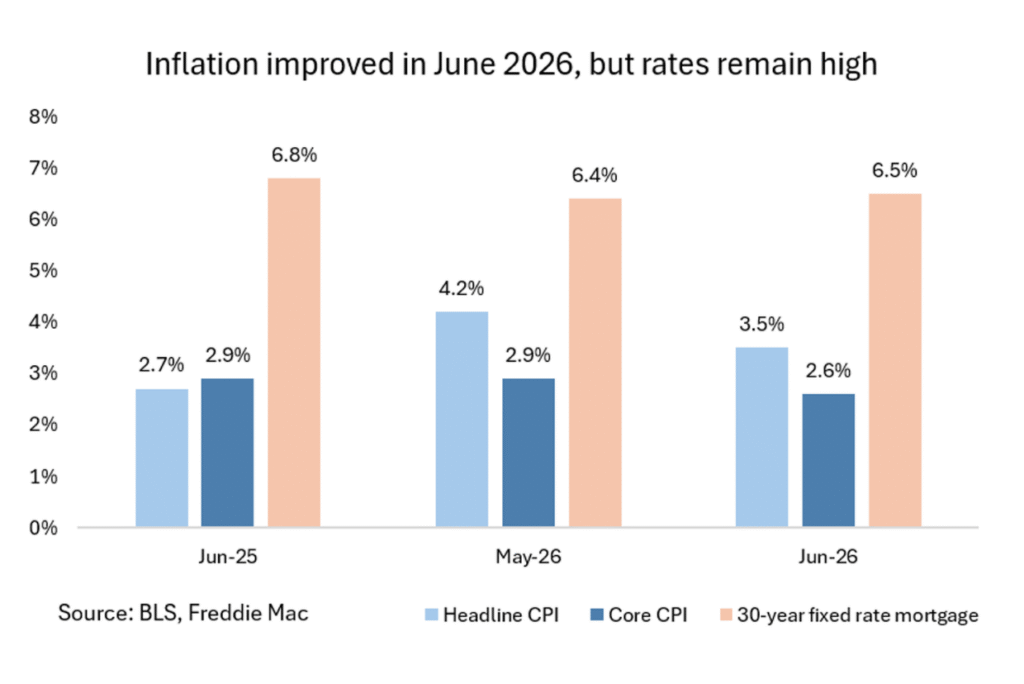
The Consumer Price Index declined 0.4% in June on a seasonally adjusted basis after rising 0.5% in May. Consumer prices were still 3.5% higher than a year earlier, while core CPI, excluding food and energy, was up 2.6% y-o-y. The monthly decline was driven primarily by a substantial drop in energy prices.
That is encouraging, but it does not mean the inflation problem has disappeared. Headline inflation remains above the Federal Reserve’s 2% objective, and one favorable month does not establish a durable trend. The Fed has consequently maintained its federal funds target range at 3.5% to 3.75% since the beginning of the year.
For housing, the most important point is that lower monthly inflation does not automatically produce lower mortgage rates. Mortgage rates are influenced heavily by longer-term Treasury yields and by the additional compensation investors demand for holding mortgage-backed securities. Bond investors are looking beyond the latest CPI report toward future inflation, economic growth, fiscal borrowing and monetary policy.
On July 16, the 10-year Treasury yield stood at 4.57%, according to the U.S. Treasury Department. That elevated long-term yield continues to keep pressure on mortgage financing costs.
Mortgage rates remain a major barrier
Freddie Mac reported that the average 30-year fixed mortgage rate rose to 6.55% on July 16, up from 6.49% the previous week. Although that was below the 6.75% rate recorded a year earlier, it remains high enough to limit purchasing power and keep monthly payments elevated. Buyers respond to the monthly payment they can obtain in the mortgage market.
At the same time, existing homeowners remain reluctant to trade mortgages obtained at much lower rates for new loans near 6.5%. High rates are therefore restricting the market from both directions: they reduce buyer demand and discourage homeowners from supplying existing homes for sale.
The labor market is cooling
The employment data also presents a mixed picture. The economy added 57,000 non-farm jobs in June, while the unemployment rate held at 4.2%. Payroll growth was close to the relatively modest average monthly gain of 36,000 during the preceding 12 months. Professional and business services, social assistance and health care added jobs, while leisure and hospitality employment declined by 61,000.
One emerging concern in the labor market is the decline in the labor force participation rate (LFPR), which measures the share of the civilian working-age population that is either employed or actively seeking work. The participation rate fell to 61.5% in June, as approximately 720,000 people left the labor force. A lower participation rate can make the labor market appear tighter than it actually is because individuals who stop looking for work are no longer counted as unemployed. Additionally, the broader U-6 unemployment rate stood at 7.9%. The U-6 measure includes not only unemployed individuals actively looking for work, but also people who are marginally attached to the labor force and those working part-time because they cannot find full-time employment, making it a more comprehensive measure of labor market underutilization.
For housing, a gradual cooling in employment has two very different implications. Slower hiring can reduce household confidence and make prospective buyers more hesitant to undertake a major financial commitment. But as long as widespread job losses do not develop, most existing homeowners are unlikely to become forced sellers.
That helps explain why the market can experience weak sales without experiencing a flood of distressed inventory. Only 2% of existing home transactions in June were distressed sales, including foreclosures and short sales (NAR data).
Existing home sales remain subdued
Existing home sales fell 2.4% from May to June, reaching a seasonally adjusted annual rate of 4.09 million. Sales were nevertheless 2.8% higher than a year earlier. The median existing home price reached $440,600, up 1.8% year over year and marking the 36th consecutive month of annual price increases.
Inventory totaled 1.56 million homes, down 0.6% from May but up 1.3% from a year ago. That represented a 4.6-month supply, unchanged from June 2025.
These figures show that demand has not disappeared. Instead, buyers remain extremely sensitive to affordability. Modest changes in mortgage rates can bring some buyers back or push them out again, creating the month-to-month volatility now visible in sales.
The market is also adjusting differently than it did in earlier downturns. Instead of widespread price declines, much of the adjustment is occurring through fewer transactions. Sellers with substantial equity and favorable mortgages often have the option to wait, while buyers remain constrained by monthly payments.
The construction headline hides a divided market
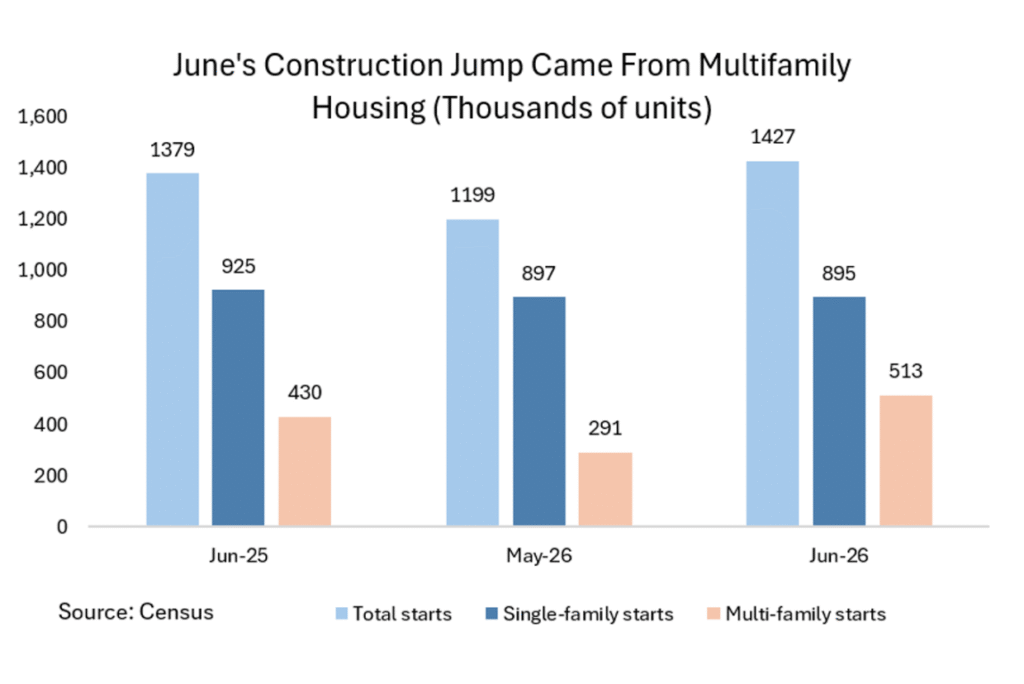
June housing starts increased 3.5% from a year ago to a seasonally adjusted annual rate of 1.427 million units. On the surface, that appears to signal a major acceleration in residential construction.
A closer look tells a different story. Single-family starts fell 3.2% to an annual rate of 895,000 from a year ago. The overall jump was driven by multifamily projects, with starts in buildings containing five or more units reaching 513,000. Single-family permits fell 2.4% to 871,000, suggesting limited momentum for detached-home construction in the months ahead.
This distinction matters because new single-family construction is essential to expanding the supply of owner-occupied housing. A rise in apartment construction can help rental supply, but it does not directly resolve the shortage of entry-level homes available to prospective buyers.
New-home sales also remained soft. In May, sales of newly built single-family homes ran at an annual rate of 580,000, while the available supply reached 10.3 months. The median new-home sales price was $424,900, essentially unchanged from May 2025.
Builders therefore face their own version of the affordability challenge. They need to produce more homes, particularly at lower price points, but elevated financing, land, labor and construction costs make that difficult.
What happens next?
The economy is not giving the housing market a single clear signal. Inflation is improving, but Treasury yields remain elevated. Employment is expanding, but slowly. Total construction rose sharply, but single-family building did not. Home sales are higher than last year, yet still historically weak.
That combination is likely to keep housing in a low-activity equilibrium: enough economic strength to prevent a broad downturn, but not enough affordability relief to produce a meaningful rebound.
Related Articles...
Housing Affordability: Is Homeownership Becoming a Luxury?
Housing affordability has become one of the defining economic challenges facing Americans. This report examines the economic forces making it harder than ever to buy a home and explains why the gap between homeowners and aspiring buyers continues to widen despite signs of improvement in the broader economy.
Is Homeownership Becoming a Luxury in America?
In the 13th episode of RiskWire: On the House, Veros’ Senior Research Economist discusses whether homeownership is becoming a luxury in the United States. She considers mortgage rates, home prices, and the lock-in effect as they relate to the 2026 housing market.

About Reena Agrawal, Senior Research Economist
Reena Agrawal received her PhD in Economics from Vanderbilt University and MA in Economics from The Ohio State University and has several years of industrial experience in economic research and analysis.