


SANTA ANA, Calif., July 8, 2026 —Today, Veros Real Estate Solutions (Veros®), an industry leader in enterprise risk management and collateral valuation services, released its Q2 2026 VeroFORECASTSM, projecting that U.S. home prices will rise just 1.1% over the next 12 months. VeroFORECAST evaluates home prices in over three hundred of the nation’s largest housing markets, and Veros is committed to the data science of predicting home value based on rigorous analysis of the fundamentals and interrelationships of numerous economic, housing, and geographic variables pertaining to home value.
The biggest surprise of 2026 is not that the housing market has slowed. It is that the housing market continues to hold its ground. Housing activity remains well below the frenzied pace of the pandemic years, but the collapse many expected has never materialized. Instead, the market has settled into an uncomfortable equilibrium where buyers and sellers are both frustrated, yet neither has enough incentive to fundamentally change the market’s direction.
The first half of 2026 offered no shortage of reasons for housing to weaken further. The Iran war briefly sent oil prices sharply higher, reigniting inflation concerns and pushing long-term interest rates upward. Financial markets braced for another spike in mortgage rates. Instead, borrowing costs remained below where they were a year earlier, allowing housing demand to modestly outperform 2025. Buyers have not abandoned the market; they simply cannot participate as easily as they once could.
Affordability remains the defining problem.
Mortgage rates continue to hover in the mid-6% range, an improvement from last year but still far above the levels that fueled the housing boom. Meanwhile, price appreciation has slowed considerably, but slower appreciation does not make homes affordable when prices are already elevated. The affordability problem extends well beyond housing. Inflation reached 4.2% year-over-year in May 2026, and although price pressures are expected to ease as the geopolitical premium on oil fades, inflation is still likely to remain above the Federal Reserve’s 2% target. Consumers are not just paying more for homes. They are paying more for nearly everything else, from insurance and utilities to food and transportation.
Supply has improved, but not enough to fundamentally change the market. Buyers now have considerably more homes to choose from than they did during the inventory-starved years of 2021 and 2022, helping moderate price growth and keep transactions moving. Still, inventory remains constrained because today’s market is stuck in a stalemate. Millions of homeowners remain locked into mortgage rates that are unlikely to be available again anytime soon. Others continue to anchor to pandemic-era prices and prefer to withdraw their listings rather than negotiate. Even retirees, traditionally an important source of supply, are finding that downsizing often provides little financial benefit when replacement homes remain expensive and financing costs are substantially higher.
The headline numbers tell only part of the story. The real story of 2026 is unfolding at the local level, where housing markets are moving in very different directions.
While much of the country continues to wrestle with affordability and sluggish sales, several markets in the Northeast and Midwest are quietly outperforming the national average. These markets are being driven by something much more fundamental: affordability. Buyers are increasingly gravitating toward communities where home prices remain within reach, local economies are stable, and limited housing supply continues to support home values.
The strongest-performing markets in the Q2 2026 VeroFORECAST include Manchester, NH; Rochester, NY; South Bend, IN; Rockford, IL; Springfield, MA; Norwich and Hartford, CT; Reading, PA; Racine, WI, and Lancaster, PA. Forecasted appreciation in these markets ranges from 3.6% to 4.2% over the next year.
The 10 Strongest-Performing Markets Over Next 12 Months
| Rank | Markets |
Forecast Data Q2 2026- Q2 2027 |
|---|---|---|
| 1 | MANCHESTER-NASHUA, NH | 4.2% |
| 2 | ROCHESTER, NY | 4.1% |
| 3 | SOUTH BEND-MISHAWAKA, IN-MI | 4.0% |
| 4 | ROCKFORD, IL | 4.0% |
| 5 | NORWICH-NEW LONDON-WILLIMANTIC, CT | 3.9% |
| 6 | HARTFORD-WEST HARTFORD-EAST HARTFORD, CT | 3.8% |
| 7 | READING, PA | 3.8% |
| 8 | RACINE-MOUNT PLEASANT, WI | 3.7% |
| 9 | SPRINGFIELD, MA | 3.7% |
| 10 | LANCASTER, PA | 3.6% |
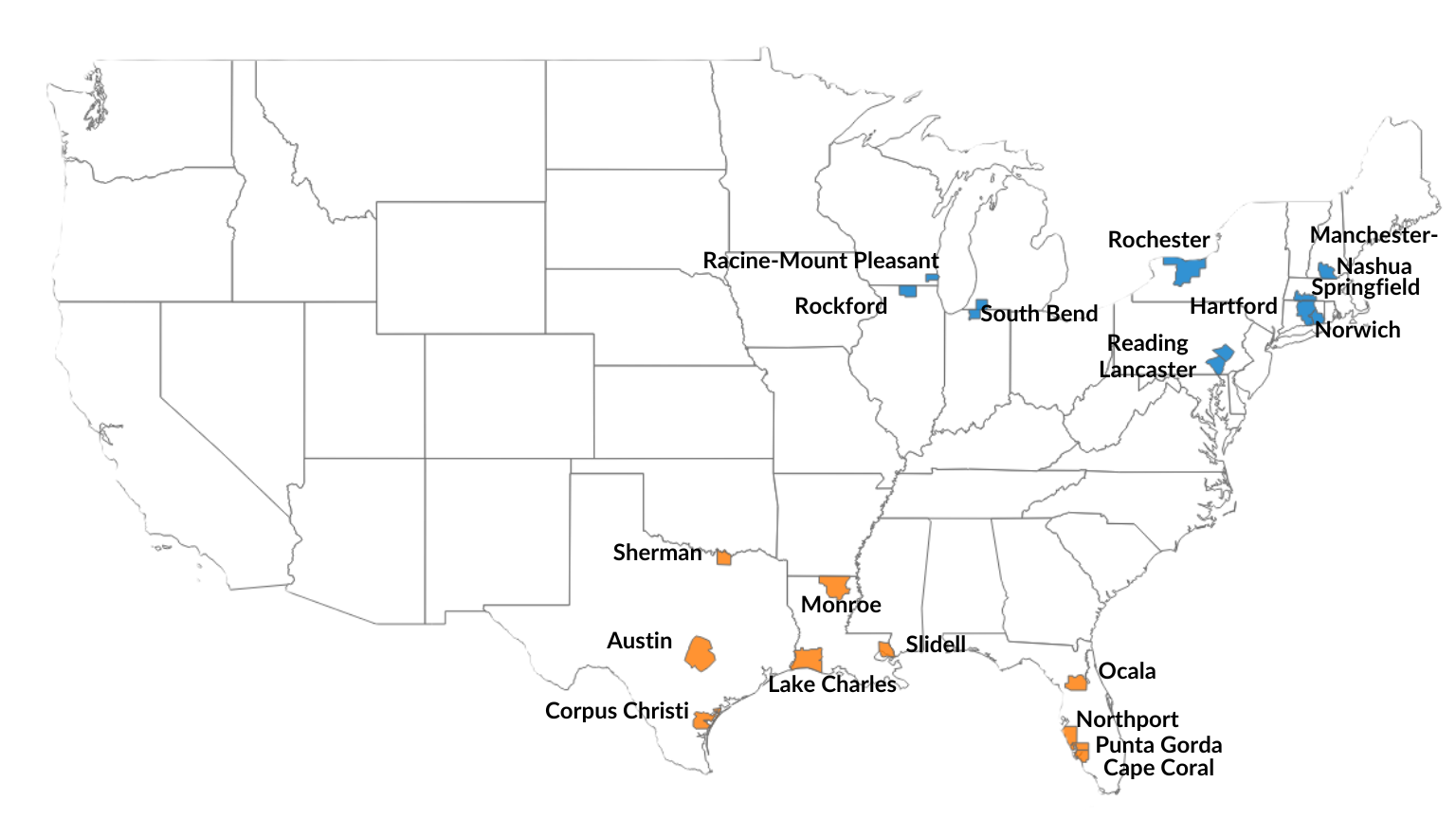
By contrast, several Sun Belt markets that surged during the pandemic boom are now facing the other side of that cycle. Markets such as Cape Coral, Punta Gorda, Ocala, and North Port in Florida; Austin, Corpus Christi, and Sherman in Texas; and Monroe, Lake Charles, and Slidell in Louisiana are forecast to post modest price declines over the next 12 months.
The 10 Least-performing Markets Over Next 12 Months
| Rank | Metropolitan Statistical Area (MSA |
Forecast Data Q2 2026 - Q2 2027 |
|---|---|---|
| 1 | CAPE CORAL-FORT MYERS, FL | -2.7% |
| 2 | AUSTIN-ROUND ROCK-SAN MARCOS, TX | -1.7% |
| 3 | MONROE, LA | -1.4% |
| 4 | CORPUS CHRISTI, TX | -1.1% |
| 5 | SHERMAN-DENISON, TX | -1.1% |
| 6 | PUNTA GORDA, FL | -1.0% |
| 7 | LAKE CHARLES, LA | -1.0% |
| 8 | OCALA, FL | -1.0% |
| 9 | NORTH PORT-BRADENTON-SARASOTA, FL | -0.9% |
| 10 | SLIDELL-MANDEVILLE-COVINGTON, LA | -0.8% |
The Q2 2026 VeroFORECAST℠ suggests that the U.S. housing market has avoided a major downturn, but it has not escaped its deeper problem. Until affordability improves meaningfully, housing will continue to move forward slowly, unevenly, and with far less momentum than buyers, sellers, or the broader economy would like.
VeroFORECAST Methodology
The quarterly VeroFORECAST reports to clients by subscription and to industry media in a summary overview. The current report is based on 326 Metropolitan Statistical Areas (MSAs) data, including 17,800 ZIP codes, 977 counties, and 82% of U.S. population covered. The report is a projected increase twelve months forward.
Source: Veros Real Estate Solutions
This information is intended for use by the media for economic reporting and should only be used for physical or digital publication or broadcast, in whole or in part, and must be sourced from Veros Real Estate Solutions. The company name must be visible on the screen or website if the data are illustrated with maps, charts, graphs, or other visual elements. For questions, analysis, interpretation of the data, or permission to reproduce, contact communications@veros.com.
About Reena Agrawal, Senior Research Economist
Reena Agrawal has a Ph.D. in Economics from Vanderbilt University. She has fifteen years of experience in macroeconomic forecasting, sectoral research, feasibility studies of complex projects, and preparing reports for multi-national clients.
About Veros Real Estate Solutions
A mortgage technology innovator since 2001, Veros is a proven leader in enterprise risk management and collateral valuation services. The firm combines predictive technology, data analytics, and industry expertise to deliver advanced automated solutions that control risk and increase profits throughout the mortgage industry, from loan origination to servicing and securitization. Veros’ services include automated valuation, fraud and risk detection, portfolio analysis, forecasting, and next-generation collateral risk management platforms. Veros is the primary architect and technology provider of the GSEs’ Uniform Collateral Data Portal® (UCDP®). Veros also works closely with the FHA to support its Electronic Appraisal Delivery (EAD) portal. The company is also making the home-buying process more efficient for our nation’s Veterans through its appraisal management work with the Department of Veterans Affairs. For more information, visit www.veros.com or call 866-458-3767.
Media Contact
Heather Zeller, Vice President of Marketing
communications@veros.com
(714) 415-6300
Original Source via Businesswire