

Housing affordability has become one of the defining economic challenges facing Americans. After years of rising home prices, elevated mortgage rates, and increasing insurance costs, purchasing a home has become significantly more difficult than it was just a few years ago. While affordability has stabilized in recent quarters, new research from Oxford Economics shows that the financial barriers to homeownership remain substantially higher than before the pandemic.
For many households, particularly first-time buyers, homeownership increasingly depends not only on income, but also on accumulated wealth, family financial support, and geographic location.
How Much Has Housing Affordability Changed?
Oxford Economics estimates that a household needed an annual income of $110,100 in the third quarter of 2025 to purchase the median-priced single-family home while covering mortgage payments, property taxes, and homeowners’ insurance. Although this represents a modest 2.3% improvement from the affordability low reached in the first quarter of 2025, it is nearly double the $58,400 required just five years earlier.
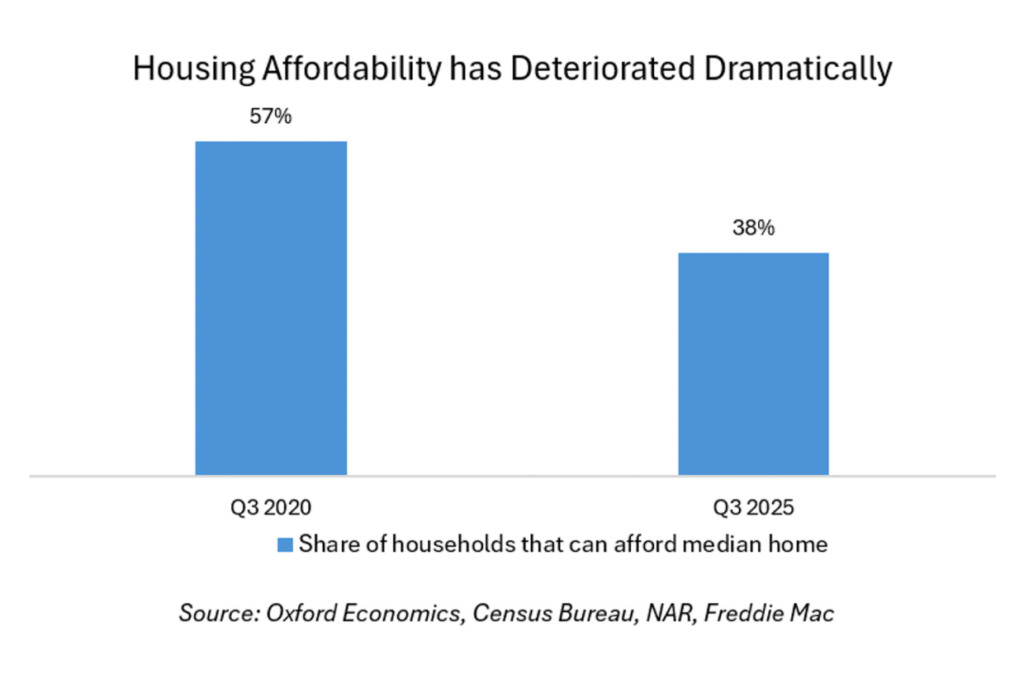
The result is a dramatic reduction in the number of households that can afford to buy a home. Only 38% of U.S. households earned enough income to purchase the median-priced home in the third quarter of 2025, down from 57% in 2020. In just five years, millions of households have effectively been priced out of homeownership.
Why Are Mortgage Rates Hurting Affordability More Than Home Prices?
Many discussions about housing affordability focus almost exclusively on rising home prices. While prices remain elevated, Oxford Economics concludes that higher mortgage rates have had an even greater impact on affordability.
Between the third quarter of 2020 and the third quarter of 2025, the national median existing-home price increased 36%, reaching $417,100. Over the same period, however, the average 30-year mortgage rate climbed from approximately 3.0% to 6.6%, dramatically increasing monthly borrowing costs. Property taxes and homeowners’ insurance have also continued to rise, further increasing the total cost of homeownership.
Higher mortgage rates also slow wealth accumulation. At today’s mortgage rates, borrowers spend much more of their monthly payment on interest during the early years of the loan. Oxford Economics estimates that with a 6.55% mortgage rate, the principal portion of the payment does not exceed the interest portion until approximately the 20th year of a 30-year mortgage. Five years ago, when mortgage rates were below 3%, borrowers reached that point around the seventh year.
Housing Affordability Is More Than a Monthly Mortgage Payment
Qualifying for a mortgage is only one hurdle facing prospective homeowners.
Buyers must also save for a down payment, pay closing costs, maintain emergency savings, and feel financially secure enough to take on what is often the largest financial commitment of their lives. At the same time, homeowners’ insurance premiums continue to rise. Oxford Economics reports that insurance costs increased 8.9% during 2025, with particularly rapid increases in states such as Florida, North Carolina, and South Dakota.
The affordability challenge therefore extends well beyond the purchase price of a home. It increasingly reflects the total cost of ownership.
Where Is Housing Still Affordable?
Housing affordability varies dramatically across the country.
Oxford Economics identifies San Jose, San Francisco, Honolulu, Los Angeles, and San Diego as the nation’s least affordable metropolitan areas. In each of these markets, no more than 17% of households earn enough income to purchase the median-priced home.
By contrast, several Midwestern markets continue to offer comparatively better affordability. Among the nation’s largest metropolitan areas, Pittsburgh, Cleveland, Oklahoma City, Louisville, and Memphis remain among the most affordable. Across all 173 metropolitan areas studied, Erie, Pennsylvania; Toledo, Ohio; Canton, Ohio; Wichita Falls, Texas; and Florence, South Carolina ranked as the most affordable.
Even these markets, however, have experienced significant deterioration. Oxford Economics found that the income required to purchase the median-priced home increased by at least 64% in the most affordable metros between 2020 and 2025, demonstrating that affordability has worsened almost everywhere.
What Does Declining Housing Affordability Mean for First-Time Buyers?
The impact of worsening affordability extends beyond today’s housing market.
According to the National Association of Realtors, the typical first-time homebuyer is now 40 years old, compared with 30 years old in 2010. Meanwhile, the first-time buyer share has fallen from 40% to 21% over the same period. More buyers are also relying on financial assistance from family members to purchase their first home.
Delaying homeownership delays wealth accumulation. Purchasing a home earlier in life allows households to build equity through mortgage repayment and home price appreciation over many years. Buyers who postpone homeownership by a decade also postpone many of those wealth-building opportunities.
This raises an important economic question. If homeownership increasingly depends on existing wealth or family financial assistance rather than earned income alone, access to one of America’s primary avenues for building wealth may become increasingly unequal.
Can Housing Affordability Improve?
There are reasons for cautious optimism.
Oxford Economics notes that affordability has improved modestly since reaching its lowest point in early 2025 as mortgage rates have eased from their 2023 peak. Looking ahead, Veros forecasts that mortgage rates will gradually decline toward 6.0% by 2028, while home price growth slows but remains positive.
However, lower mortgage rates alone are unlikely to fully restore affordability. Rising property taxes and homeowners’ insurance are expected to continue increasing housing costs, offsetting some of the benefit from lower borrowing costs. Long-term improvement will also depend on expanding the supply of homes, particularly entry-level housing that provides first-time buyers with an affordable point of entry into the market.
What it means
Homeownership has not become a luxury in the traditional sense. Millions of Americans continue to purchase homes every year, and approximately 65% of U.S. households own the homes they live in.
Yet the pathway to homeownership has unquestionably become more difficult. Housing affordability has deteriorated dramatically since the pandemic, and the financial barriers to buying a home now extend well beyond mortgage rates and home prices. Restoring affordability will require addressing not only borrowing costs, but also insurance costs, housing supply, and the growing gap between incomes and the total cost of homeownership.

About Reena Agrawal, Senior Research Economist
Reena Agrawal received her PhD in Economics from Vanderbilt University and MA in Economics from The Ohio State University and has several years of industrial experience in economic research and analysis.